Domo Jupyter workspaces don't use standard Jupyter APIs — and if you assume they do, your authentication will silently fail every time.
Standard Domo API calls use an X-Domo-Authentication header built from a username/password/instance exchange. Jupyter workspaces break that contract. Understanding why it's different — and how to build a clean Python abstraction around it — is the gap this series closes.
Why It Matters
Automating Jupyter workspace interactions (running notebooks, pushing data, triggering executions) requires a separate auth flow that isn't documented. Without it, you're stuck manually operating workspaces through the UI. Beyond the auth problem, building this kind of tooling in raw scripts gets brittle fast — this video uses the challenge as a practical forcing function for learning Python OOP patterns (dataclasses, inheritance, composition) that scale to more complex integrations.
What You'll Learn
- Understand why Domo Jupyter's API authentication differs from standard Domo API auth
- Inspect live network traffic to reverse-engineer undocumented auth flows
- Use
python-dotenvto manage credentials safely in notebooks - Build a
FullAuthclass that generates valid auth headers for standard Domo APIs - Apply inheritance and composition patterns to extend dataclasses cleanly
Breaking Down Domo's Auth Boundary — and How to Model It in Python
The video opens by demonstrating standard Domo auth: instantiate a FullAuth class with a username, password, and Domo instance, then call generate_auth_header() to produce an X-Domo-Authentication token. That token works for dataset CRUD, dataflow triggers, user management — everything in the undocumented API surface. It's a clean pattern, and Domo Library encodes it as a reusable class.
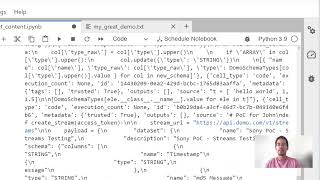
The pivot comes when the author inspects a PUT request to a Jupyter workspace via browser network traffic. The request structure is different. The auth mechanism Jupyter uses doesn't match what FullAuth produces — which means the existing class hierarchy needs to be extended, not replaced.
This is where the OOP angle becomes practical rather than academic. Rather than writing a standalone script for Jupyter auth, the series uses inheritance to build a new class that shares the core auth logic while overriding the pieces specific to Jupyter. Composition handles cases where behavior should be mixed in without creating deep inheritance chains.
The credential hygiene piece is worth calling out explicitly: the video consistently uses .env files via python-dotenv rather than hardcoding values in notebooks. For anyone building tools they intend to share or demo publicly, this is non-negotiable — clear-text credentials in notebooks get committed, screenshotted, and leaked constantly.
This first video in the four-part series lays the conceptual groundwork: here's what standard auth looks like, here's the class that models it, and here's the network evidence that Jupyter requires something different. The follow-on videos build the Jupyter-specific implementation on top of this foundation.