Instance Management & Data Accuracy
Domo Governance and Stats datasets Beast Mode Manager Lineage and Impact Analysis Automated Data Profiler & Alerts Certification
Data Security & User Access
PDP Custom Roles SSO Adhoc + Dynamic User Groups + Trusted Attributes Accounts API and Framework
Data Misuse & User Behavior
Quick Starts (Activity Log)
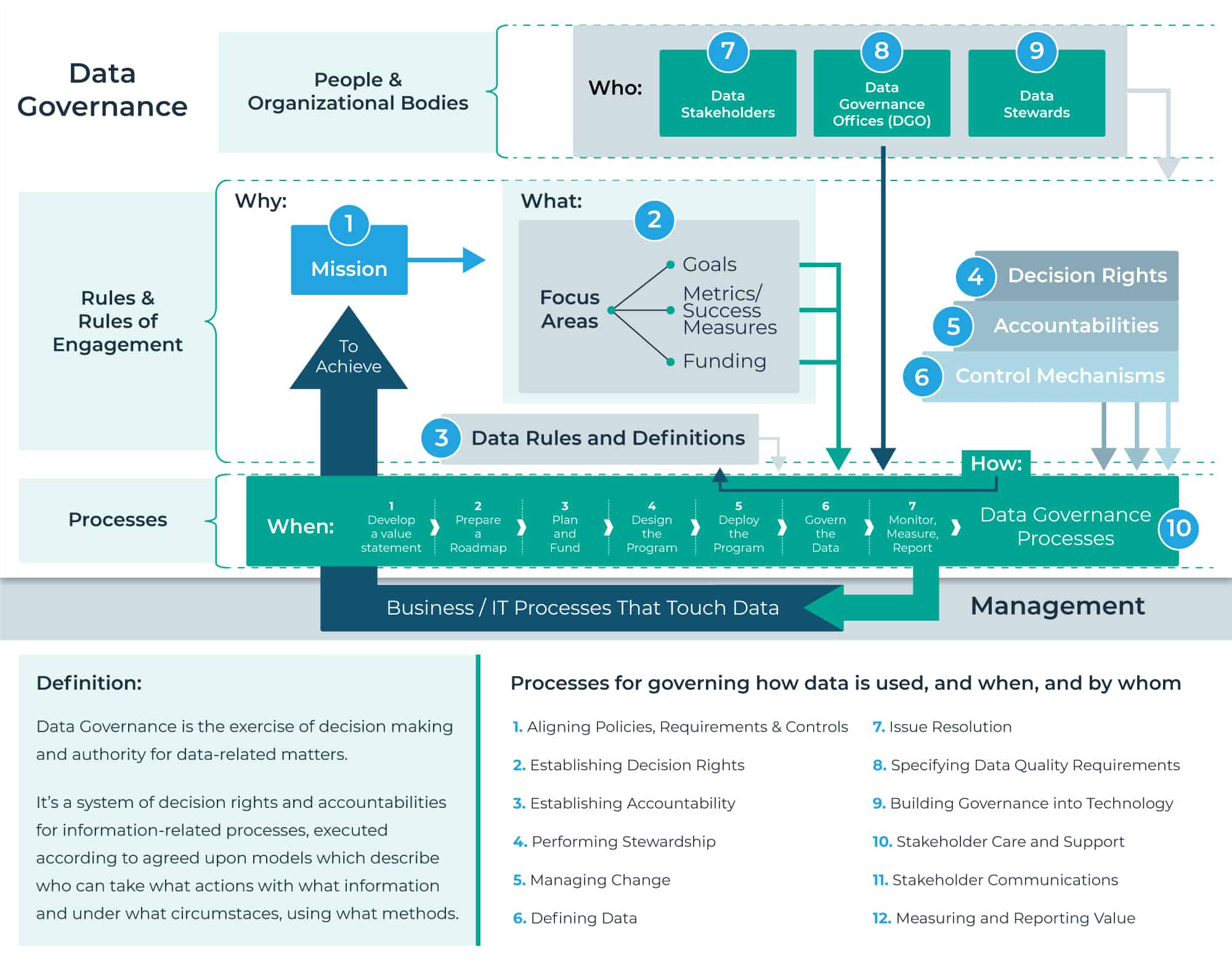
Mission: What are the goals of your data governance program?
- Make consistent, confident business decisions based on trustworthy data aligned with all the various purposes for the use of the data assets within the enterprise
- Meet regulatory requirements and avoid fines by documenting the lineage of the data assets and the access controls related to the data
- Improve data security by establishing data ownership and related responsibilities
- Define and verify data distribution policies including the roles and accountabilities of involved internal and external entities
- Use data to increase profits. Data monetization starts with having data that is stored, maintained, classified, and made accessible in an optimal way.
- Assign data quality responsibilities in order to measure and follow up on data quality KPIs related to the general performance KPIs within the enterprise
- Plan better by not having to cleanse and structure data for each planning purpose
- Eliminate re-work by having data assets that are trusted, standardized, and capable of serving multiple purposes
- Optimize staff effectiveness by providing data assets that meet the desired data quality thresholds
- Evaluate and improve by rising the data governance maturity level phase by phase
- Acknowledge gains and build on forward momentum in order to secure stakeholder continuous commitment and a broad organizational support
* source: Profisee article
What do you want to accomplish?
- Enumerate your goals
- Define success criteria and associated metrics
- How will you fund, allocate resources
* original image
Who will be involved?
- Data Owners (sponsors) are ultimately accountable for the state of the data as an asset. These must be people that are able to make decisions and enforce these decisions throughout the organization. Data owners can be appointed at the entity level (eg customer records, product records, employee records, and so forth) and supplementary on attribute level (eg customer address, customer status, product name, product classification, and so forth).
- Data Stewards (data champions) make sure that the data policies and data standards are adhered to in daily business. These people will often be the subject matter experts for a data entity and/or a set of data attributes. Data stewards are either the ones responsible for taking care of the data as an asset or the ones consulted in how to do that.
- Data Custodians (data operators) manage the business and technical onboarding; maintenance; and end-of-life updates to your data assets.
- Data Governance Committee approves data policies and data standards and handle escalated issues. Depending on the size and structure of your organization there may be sub fora for each data domain (eg customer, vendor, product, employee).
How will you implement it?
- Decision Rights?
- Accountability?
- Control Mechanisms
15 Steps for Data Governance
- Start small. As in all aspects of business, do not try to boil the ocean. Strive for quick wins and build up ambitions over time.
- Set clear, measurable, and specific goals. You cannot control what you cannot measure. Celebrate when goals are met and use this to go for the next win.
- Define ownership. Without business ownership, a data governance framework cannot succeed.
- Identify related roles and responsibilities. Data governance is a team effort with deliverables from all parts of the business.
- Educate stakeholders. Wherever possible use business terms and translate the academic parts of the data governance discipline into meaningful content in the business context.
- Focus on the operating model. A data governance framework must integrate into the way of doing business in your enterprise.
- Map infrastructure, architecture, and tools. Your data governance framework must be a sensible part of your enterprise architecture, the IT landscape, and the tools needed.
- Develop standardized data definitions. It is essential to strike a balance between what needs to be centralized and where agility and localization work best.
- Identify data domains. Start with the data domain with the best ratio between impact and effort for rising the data governance maturity.
- Identify critical data elements. Focus on the most critical data elements.
- Define control measurements. Deploy these in business processes, IT applications, and/or reporting where it makes the most sense.
- Build a business case. Identify advantages of rising data governance maturity related to growth, costs savings, risk, and compliance.
- Leverage metrics. Focus on a limited set of data quality KPIs that can be related to general performance KPIs within the enterprise.
- Communicate frequently. Data governance practitioners agree that communication is the most crucial part of the discipline.
- It’s a practice, not a project.
* most of this content was copied from Profisee's data governance blog post.
Additional Reading
How Data Governance Drives Successful Business Results.
Warning: Mind the Data Governance Gap in Self-service BI
How to secure data lakes: What you don't know can hurt you
DATA GOVERNANCE – WHAT, WHY, HOW, WHO & 15 BEST PRACTICES
https://profisee.com/data-governance-what-why-how-who/
How to use the Data Governance Framework